斯坦福监狱实验 :6天让一个好人变坏 ! 我们以为的善良其实不堪一击 ...

▲ 扫码进入铺子吧~
酒馆全新板块【Mind on the Rocks】心理加点冰上线了,下文是全英文逐字稿和音频哦~
小伙伴们如果有任何感兴趣的话题或者对本期节目的观后感,也欢迎评论区留言哈~
Mind on the Rocks
加小助手VX【luluxjg1】领取全文逐字稿
< KEY WORDS >
🔺收听音频
Definition of the Lucifer Effect
• Origin: Philip Zimbardo, book The Lucifer Effect (2007)
•Meaning: Ordinary people may commit cruel acts under certain situations
•Lucifer reference: the fallen angel
Analogy: Bad apples vs bad barrels
•Common view: bad people (bad apples) are the problem
•Zimbardo’s idea: the environment / system (the barrel) can corrupt people
•Three layers to analyze: the individual, the situation, those who run the system
•Note: these three groups are not always the same people
The Stanford Prison Experiment (1971)
Setup: basement of Stanford psychology building → pretend prison
Participants: screened, healthy young male volunteers, paid
Random assignment: guards / prisoners (by drawing lots, no pre selected cruel people)
•Experiment design details
•Prisoners: mock arrest, search, uniform with numbers, ankle chain, loss of real names
•Guards: uniforms, whistles, mirrored sunglasses
•Remove personal identity: clothes, names, appearance taken out of the picture
•Built in power imbalance before the experiment really began

Mind on the Rocks

Hi, everyone and welcome back to Happy Hour. 欢迎回来酒馆. Hi, 安澜.
Hi, Lulu, hi, everyone.
Today we're going to launch or try out a new segment.
Yes. Now this is something that we both absolutely love, psychology.
Well, pop psychology.
Pop psychology.
We're not that academic about it.
No, not in the slightest. So, this is our new segment.
And it's called....
Mind on the rocks.
《心理加点冰》. 安澜 came up with this name. I mean, I love it because it's really in tune with our alcoholic theme.
Yeah.
But why加点冰? Why on the rocks?
Well, basically, something that is very, very strong. Like a nice cocktail, but you add just a few ice cubes to make it clearer and to also make it a little bit less strong.
To make it cooler, man might say.
Exactly. Because the thing is about psychology, is one of those things that looks very, very complicated. So, what we wanna do is we wanna take some common theories, common ideas and explain them in a way that is relaxing and also fun.
Okay. So, what is going to be our first topic in this new segment.
Well, before we move on to the topic, I have a question for you.
Okay.
Would you describe yourself as a good person.
Okay. That's a suspicious way to start a conversation. Depends on who is asking I guess, what have you heard?
Nothing. Don't worry, but would you?
Generally, yes. I mean I try to be considered, I'm polite. And I… I genuinely feel guilty if I'm doing things that are, well, not so nice. Like I feel guilty when I'm rude to people, why?
Because today's topic asks whether people like that, people who think that they are decent, kind, nice, can end up treating others terribly.
Again, what have you heard?
Nothing, whatever.
All right, I think I’ve read about this one before. In what kind of situation, in certain type of context. Perfectly nice people can end up doing horrible things to others.
Precisely. And today we are talking about the Lucifer effect.
对路西法效应. Lucifer is the fallen Angel, is the devil, right?
Yeah. We'll explain that little bit later. But the Lucifer effect is from a very famous psychologist Philip Zimbardo.
Mhm.
And his explanation of how ordinary people can be involved in cruel or destructive behavior.
Oh, you're gonna talk about the infamous prison experiment.
Yes. But also, not just the prison experiment, but some other ways in which the Lucifer effect can be seen.
Ok. So first of all, why Lucifer? Sounds like we're about to discuss a horror film.
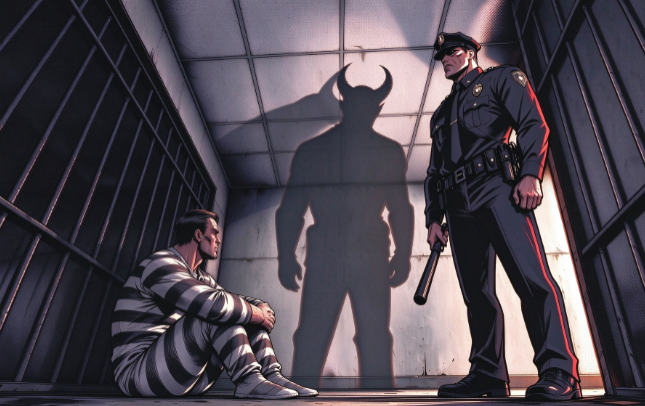
Well, as you say, the name refers to the Christian tradition of Lucifer. Now Lucifer was an Angel who fell after rebelling against God and he becomes Satan.
Satan, right?
Yeah.
Lucifer is Satan.
Yeah.
Later on became Satan.
And Zimbardo uses that image of transformation for his book The Lucifer Effect published in 2007.
An Angel becoming a devil, quite a dramatic title for a psychology book. Actually I think I have that book somewhere on the shelves.
Well, it is quite a popular book. And his central argument was that when someone does something terrible, we shouldn't only ask what's wrong with that person. We should also examine the situation around them.
The situation around them, the context like I said, but exactly what sort of situation you're talking about.
Who has power, what the group expects, whether anyone is watching, whether hurting someone brings a reward or refusing to hurt them brings punishment.
So, someone’s behavior might change without their whole personality suddenly changing. They are just somehow changed by the environment.
Well, yeah. They might still be kind to their family. They might still have lots of friends. But when they go to work. They might treat people very, very differently.
Kind of… I don't know if it’s the Lucifer effect, but those people who are hiding behind anonymity of the internet and just says really nasty things to people. But they can be perfectly nice and respectable people in day-to-day life.
Well, yeah. Because it's all based on whether anyone is watching. And to be honest, this is a very uncomfortable thing because we like clear categories, a good person, bad person.
Yeah.
Think about films, the bad person is always, always bad. Everything they do is evil.
They are very flat or stock characters, aren't they? 非常那种扁平化的.
Yeah.
So the heroes they always do heroic things and the baddies, the villains are always mwahahaha....
Exactly. Now Zimbardo used a very simple comparison, bad apples and bad barrels.
Bad apple, isn't that like kind of an idiom? It just means like a troublesome person, like a bad person.
Yep. So, one bad apple in the batch ruins all the other apples.
中文叫什么你知道吗? 就是一颗老鼠屎坏了一锅粥.
Yeah. So how he means is that if someone behaves badly, we call them a bad apple and we remove them.
Yeah.
And everything is fine. But what if the barrel, what if the environment itself is encouraging that behavior?
So, if the barrel is bad, then all of the apples will rot.
Exactly. So you take one bad apple out, but the next apple you put in will also go bad as well.
But in this reference or in this analogy, what is the barrel? Is it the society?
The barrel can be anything. The bowel can just be the physical environment; it can be the mental environment; it can be the group. So Zimbardo asks another question, who made the barrel, who created the rules and decided what would be rewarded. So basically, there are three things we need to examine.
Mhm.
The person, the situation, and the people running the system.
Hang on a minute. So, when you say the person, the situation I understand and the people running the system, is this… are you talking about the person, meaning the person who made the system and the people meaning the people who are running the system.
Well, the person is the person inside the system, inside the environment. The people running the system could be the ones who created it, could be the ones who are responsible for maintaining it, or it could be the ones that are simply in control.
Okay.
So, it doesn't necessarily have to be the same group of people, as we'll see with this experiment.
Yeah. I thought…because we're now talking about theories which can be a bit confusing. I guess, the best way to really go about it is to run us... is to walk our audience through the experiment.
Exactly. So let's go into the basement. Now it's August 1971, at Stanford University in California, Zimbardo and his team have turned part of the psychology buildings basement into a pretend prison.
You said pretend prison, who did they put into it? They didn't really put prisoners into it.
No, they recruited volunteers.
Let me guess, college kids.
Yeah. And young men.
Oh, okay.
So young men, mostly college students, and they were paid for it.
Okay.
They were screened though, for physical or psychological health problems. And then, they were assigned to be guards or prisoners at random.
At random. Okay, so it's not really like ,okay安澜, you look like the prisoner, so you ...
Yeah.
So it was more like drawing lots. 像抽签那种,就是随机的.
Exactly. So getting the evil role is a matter of chance.
Okay.
So, the guards weren't chosen because they seem cruel or aggressive. They were just chosen completely at random.
I see. So, you could have been chosen as a guard.
Yeah.
All right. So what happens or what happened in that experiment?
Well, the prisoners arrived when they were actually “arrested”, and this was actually done with the help of the local police.
Wow. They’re really做戏做全套.
Yeah.
Really made it real.
And at the pretend prison, they were treated like (the way) they would be (treated) in any other prison. They were searched, stripped and sprayed as part of the arrival procedure.
Wow, okay. I wouldn't want to be stripped.
Well, yeah. Then they were given kind of like prison clothes, loose clothes with numbers on them.
Mhm.
Rubber sandals and stocking caps to cover their hair. So, each of them actually had a chain around one of their ankles.
That's hardcore. I mean they're not really criminals.
Well, yeah. But it was basically to make them feel restricted. So even moving around, they have that physical reminder that they are prisoners, they are in prison.
What about the guards?
Well.
Do they get uniforms?
Yeah. They got uniforms, whistles, and very famously they got mirrored sunglasses.
Mirrored sunglasses? I guess that just to hide their eyes.
Yeah.
Because when you're… I think for human beings, we kind of rely on eye contact.
Yeah.
And the expressions in the eyes to connect emotionally. So, this probably make the whole thing feel colder.
Yeah.
They're like robot cops.
Pretty much. And the prisoners were addressed by their numbers. They no longer had names. All of their usual clothes, names and appearance have been sort of, taken out of the picture.
All right. You can already see a power divide before anyone has done anything, before this experiment even formally started. One group already looked more powerful. The other group looked completely powerless and restricted.
Yeah. And this was a deliberate part of the experiment. This wasn't by accident.
So let me guess it didn't go down very well.
No.

排版长图:Jer.ry
文稿校对:梅薇薇 & Jenny
图片来源:均来源于网络 | 侵删
星标 “璐璐的英文小酒馆”
听见更精彩的故事,遇见更广阔的世界






▲点击以上图片,Get世界精选好物


