耶鲁馆藏 "神秘天书 "?文字不属于任何已知语言 ,配图更是奇幻 ,有猜测来自外星 ...

铺 子
▲点击进入 相应板块
Unexplained Mysteries
BACKDROP
The Voynich Manuscript

背景介绍:
这份伏尼契手稿诞生于 1404 至 1438 年的中世纪中欧,载体为牛皮犊皮纸,墨水与颜料均匹配古中世纪工艺,并非后世伪造。
当时欧洲盛行炼金术、占星与草药医学,大量学者习惯用秘文保护独有知识,手稿创作环境充满神秘学氛围。全书现存约 240 页,部分页面遗失,通篇是一套独有的未知文字,搭配大量奇幻手绘插图,无标题、作者与解读线索。
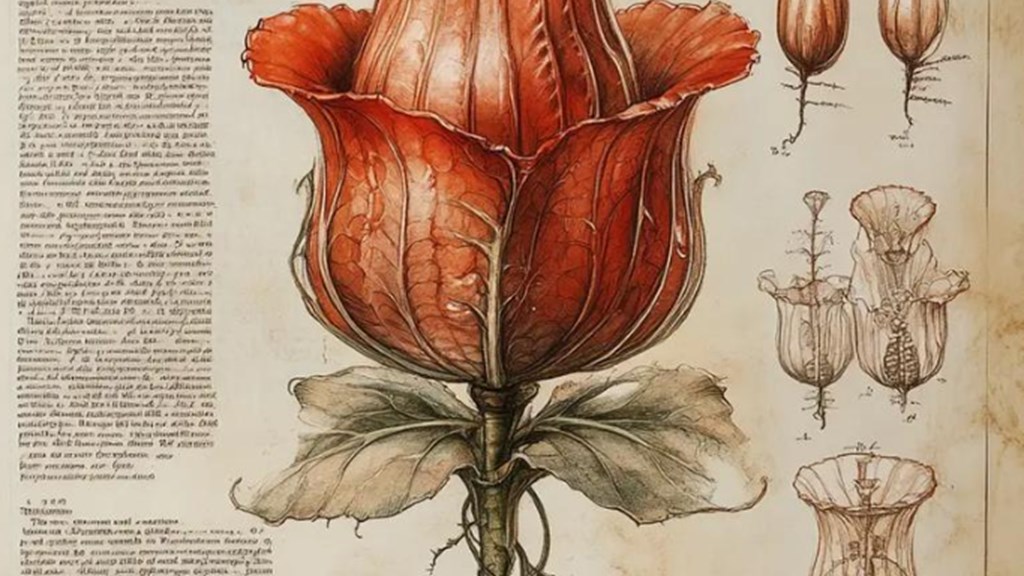
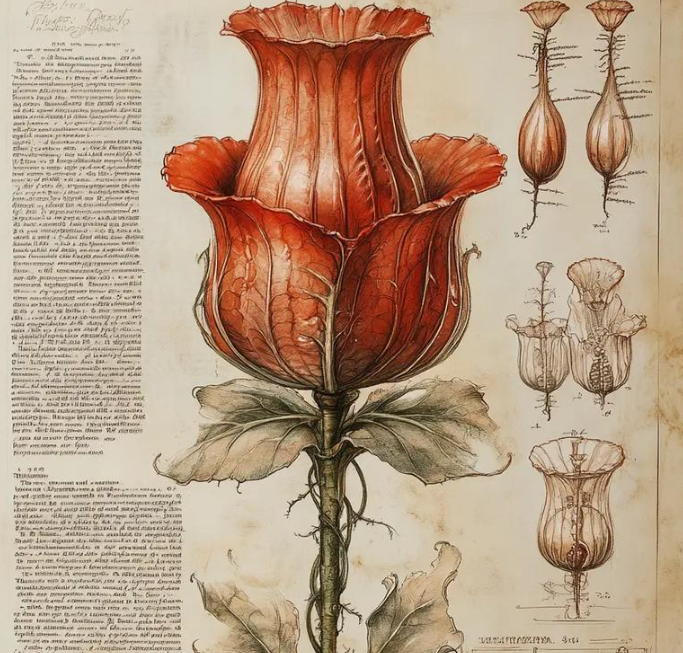
手稿文字行文流畅,字符排布符合真实语言的数理统计规律,绝非随意胡乱涂鸦,创作者对这套文字体系十分熟练。书中插画分为奇幻植物、星象天文、沐浴女性三大板块,描绘的物种、器械、星图均无法对应现实已知事物。
事件简介:
手稿最早可追溯至 17 世纪炼金术士巴雷什,他曾寄信求教顶尖学者基歇尔,却始终没能破译文本内容。
传闻神圣罗马帝国皇帝鲁道夫二世曾重金购入此书,后手稿长期隐匿于私人藏书馆,数百年间踪迹断断续续。
1912 年波兰古籍商人伏尼契在意大利耶稣会学院发现并买下手稿,将其复制分发全球专家,手稿自此得名并闻名世界。
一战、二战顶级密码专家、多国语言学者乃至现代 AI 系统轮番破解,所有解读方案均未得到学界统一认可。学界衍生出伪造密书、失传古语言、加密炼金典籍、外星记录等多种猜想,但至今没有任何理论能够完整证实。
如今手稿收藏于耶鲁大学图书馆,数百年来无人读懂完整语句,成为人类历史上最知名的文字未解之谜。
Ep/16
MYSTERIES
Unexplained Mysteries
with Anlan
Welcome to a world of secrets and unanswered questions—a world of true mysteries that no one has ever solved. Today, we are going on a journey into the strange and the unexplained.
Are you ready to explore the unknown? Let's begin.
🎵
🔺点击收听音频
In a silent reading room at Yale University, behind thick glass and under soft golden lights, lies a book that no one on Earth can read.
Its pages are made from vellum — smooth animal skin prepared more than six hundred years ago. The ink has faded to the colour of dried blood. Across every page flows elegant handwriting in a language that does not exist anywhere else in human history. The symbols twist and curve like real words. They repeat in patterns. They obey hidden rules. Yet no scholar, cryptographer, linguist, or computer has ever managed to understand a single complete sentence.
✏ Vellum 牛皮纸
✏ Handwriting 笔记
✏ Cryptographer 译解密码者
✏ Linguist 语言学家
And the pictures are even stranger.
The book is filled with drawings that seem to come from a dream — or perhaps from another world.
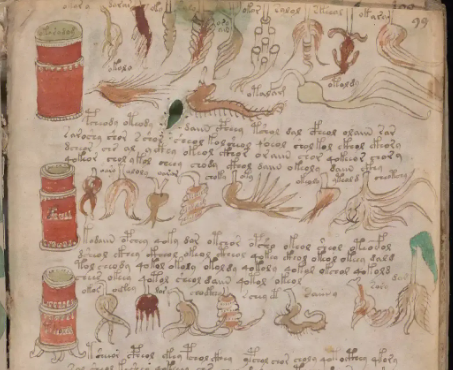
There are plants with impossible roots and flowers unlike anything found on Earth. There are suns, moons, and swirling star charts covered in mysterious symbols. Naked women float through green pools connected by strange tubes and pipes like some forgotten medieval machine. There are jars stuffed with unknown herbs, pages of recipe-like lists, and diagrams that seem to hint at medicine, astronomy, alchemy, or something far more secret.
The book has no title.
No author.
No explanation.
No key.
It simply waits in silence, as if daring humanity to unlock its secrets.
This is the mystery of the Voynich Manuscript.
✏ Stuffed with 塞满
✏ Herbs 药草,草本植物
✏ Astronomy 天文学
✏ Alchemy 炼金术
✏ Manuscript 手稿,原稿
And for more than a century, it has defeated some of the greatest minds in the world.
To understand the mystery, we must travel back to the early 15th century, to a Europe filled with superstition, plague, hidden knowledge, and dangerous new ideas.
Somewhere in Central Europe — most likely in northern Italy — an unknown writer sat down at a wooden desk lit by candlelight. Outside, church bells echoed through narrow streets. Scholars argued over astronomy and medicine. Alchemists searched for secret formulas. Monks copied ancient books by hand.
And someone began creating one of the strangest manuscripts in human history.
Modern carbon dating has revealed that the vellum pages were made between 1404 and 1438. This means the book itself is genuinely medieval. The book is not a modern fake. Someone in the Middle Ages truly created this object.
✏ Superstition 迷信
✏ Plague 瘟疫
✏ Hidden knowledge 难以获取的知识
✏ Carbon dating 碳14测年法
✏ Medieval 中世纪的
But who?
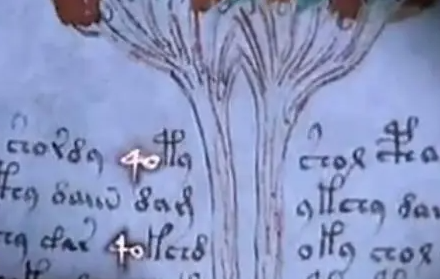
The manuscript is around 240 pages long, although some pages are missing. The text runs neatly from left to right in smooth flowing lines. The script uses around twenty to thirty strange symbols now called "Voynichese". At first glance, the writing almost looks familiar — as if it belongs to a forgotten European language. But the longer you stare at it, the stranger it becomes.
No known alphabet matches it.
No known language explains it.
No translation has ever been accepted.
And yet the writing behaves uncannily like real language.
Some words appear often. Others are rare. Certain symbols follow hidden patterns. Entire sections seem carefully organised. Computer analysis has shown that the text follows statistical rules found in genuine human communication. This is not random scribbling.
Someone knew exactly what they were writing.
✏ At first glance 乍一看
✏ Uncannily 不寻常地
✏ Rare 罕见的
✏ Statistical rules 数理分布特征 / 语言统计规律
✏ Random 随机的
✏ Scribbling 乱涂乱画
The illustrations make the mystery even deeper.
One section contains over a hundred detailed botanical drawings. Some look almost real at first — roots twisting through the soil, leaves carefully shaded, petals opening toward the sky. But botanists studying the pages realised something disturbing: many of the plants do not exist. Some seem to combine parts of different species into impossible hybrids. Others resemble nothing known in nature.
Another section appears astronomical. Large circular diagrams fill the pages. Suns blaze at the centre of strange star maps. Zodiac symbols surround mysterious figures. Tiny stars scatter across the parchment like fragments of the night sky. Some researchers believe these pages may contain hidden calendars or astrological calculations.
✏ Illustration 插画
✏ Botanical 植物学的
✏ Shaded 上色(明暗阴影渲染)
✏ Petals 花瓣
✏ Species 物种,种类
✏ Hybrids 混合物
✏ Resemble 与...相似
✏ Astronomical 天文的
✏ Zodiac symbols 星座符号
✏ Scatter 散布
✏ Calendars 历法
✏ Astrological 占星的
Then come perhaps the most unsettling images of all.
Page after page shows groups of naked women bathing in green liquid. They climb into pools, stand inside strange tubes, and move through systems of connected pipes like water flowing through a machine. Some women wear crowns. Others point toward symbols in the sky. The scenes feel strangely modern and ancient at the same time — half medical textbook, half dream.
What was the writer trying to show?
Medicine?
Alchemy?
Human anatomy?
Or something no longer understood?
For centuries, the manuscript passed silently from owner to owner like a cursed object nobody could explain.
✏ Unsettling 令人不安的
✏ Liquid 液体
✏ Anatomy 解剖学
✏ Cursed 被诅咒的
The first known owner appeared in the 1600s. His name was Georg Baresch, an alchemist living in Prague. Baresch became obsessed with the strange book. He wrote letters describing its unknown writing and bizarre illustrations. Desperate for answers, he contacted one of the most famous scholars in Europe: Athanasius Kircher, a Jesuit priest known for studying ancient languages and Egyptian hieroglyphics.
Baresch hoped Kircher could finally solve the mystery.
He could not.
Even Kircher — one of the greatest intellectuals of his age — failed to understand the manuscript.
✏ Alchemist 炼金术士
✏ Prague 布拉格
✏ Obsessed with 痴迷于
✏ Scholar 学者
✏ Jesuit 耶稣会
✏ Hieroglyphics 象形文字
✏ Intellectuals 知识分子
Around this time, the book may have also belonged to Emperor Rudolf II, ruler of the Holy Roman Empire. Rudolf loved astrology, alchemy, and strange magical objects. His palace in Prague was filled with astronomers, occultists, and collectors of rare wonders. According to later reports, he may have paid 600 gold ducats for the mysterious manuscript — an enormous fortune at the time.
Imagine that for a moment.
A medieval emperor staring at these impossible pages by candlelight, convinced he was holding hidden knowledge lost to the world.
Then the manuscript vanished again.
For centuries, it disappeared into private collections and dusty libraries while Europe changed around it. Kingdoms rose and fell. Wars exploded across the continent. Science transformed the modern world. Yet the strange unreadable book survived quietly in the shadows.
✏ Holy Roman Empire 神圣罗马帝国
✏ Occultist 术士,神秘学者
✏ Ducat 达克特(从前流通于欧洲各国的钱币)
✏ Convinced 信服的,确信的
✏ Vanished 销声匿迹
Then, in 1912, the mystery returned to life.
A Polish book dealer named Wilfrid Voynich visited a Jesuit college near Rome. Hidden among old manuscripts, he discovered the strange volume. The moment he opened it, he knew it was extraordinary.
Voynich became obsessed.
He sent copies of the pages to experts across Europe and America. Linguists studied the script. Historians examined the drawings. Cryptographers searched for hidden codes. Nobody could explain it.
The manuscript soon became famous and took the name we still use today: the Voynich Manuscript.
And the mystery only deepened.
Throughout the 20th century, some of the world’s greatest codebreakers tried to solve it. Experts who had broken military ciphers during the First and Second World Wars studied the text for years. Specialists searched for hidden mathematical patterns. Others compared it to Hebrew, Arabic, Latin, Chinese, and dozens of forgotten languages.
Every attempt failed.
Even modern artificial intelligence has joined the hunt. Powerful computers now analyse every symbol, every word pattern, every repeated phrase. High-resolution scans reveal tiny details invisible to the human eye. Yet the manuscript remains silent.
It refuses to surrender its meaning.
Science has at least confirmed one thing: the book itself is real.
✏ Codebreaker 电码译员
✏ Military ciphers 军事秘密
✏ Specialist 专家
✏ Mathematical 有关数学的
✏ Attempt 努力,尝试
✏ High-resolution 高分辨率的
In 2009, researchers at the University of Arizona performed radiocarbon dating on tiny pieces of vellum from the manuscript. The results proved the pages came from the early 15th century. Tests on the ink and pigments also matched medieval materials.
The manuscript was not created recently to trick collectors.
Someone six hundred years ago truly wrote this book.
But why?
Over the years, countless theories have tried to answer the question.
Some believe it is an elaborate hoax. Perhaps a clever medieval scholar invented a fake language to impress wealthy collectors. The strange plants and mysterious diagrams may have been designed purely to create an atmosphere of secret wonder and wisdom.
✏ Radiocarbon dating 放射性碳定年法
✏ Pigments 颜料
✏ Countless 数不尽的
✏ Elaborate hoax 精心策划的恶作剧
But many researchers doubt this explanation. Creating hundreds of pages of structured fake writing would require extraordinary effort. The text follows patterns too complex and consistent to look random.
Others believe the manuscript is written in a real but lost language. Perhaps it records medical knowledge from a forgotten culture. Some researchers think it may describe herbal medicine or women’s health. A few have claimed partial translations, but none have convinced the wider academic world.
Many experts suspect it is an encrypted text — a sophisticated medieval cipher hiding or holding dangerous or valuable knowledge. During The Middle Ages, scholars often protected important ideas using secret codes. Alchemists especially loved hidden writing.
Could the Voynich Manuscript contain forbidden scientific knowledge? Religious secrets? Medical discoveries?
✏ Encrypted 加密的
✏ Sophisticated 精密的,水平高的
✏ Cipher 密码,暗号
✏ Forbidden 禁忌的
Or something far stranger?
The wildest theories move beyond history entirely.
Some claim the manuscript was written by an alien visitor. Others think it records visions experienced during mystical trances.
A few even suggest it contains knowledge far ahead of its time — astronomy, biology, or technologies not yet discovered in medieval Europe.
None of these ideas have been proven.
But perhaps the true power of the Voynich Manuscript is not the answer.
It is the feeling the book creates.
✏ Alien visitor 外星访客
✏ Mystical trances 神秘入定幻境
Open its pages and you feel as if you are standing at the edge of another reality. Everything looks meaningful. Everything feels deliberate. Yet the meaning remains forever out of reach.
For six centuries, generation after generation has stared at the same strange symbols with the same mixture of excitement and frustration.
Imagine the unknown writer sitting alone beside flickering candlelight. Ink stains cover their fingers. Outside, winter winds rattle against wooden shutters. Slowly, carefully, they draw impossible plants and fill page after page with mysterious flowing writing.
Did they believe someone in the future would understand?
Or was the book never meant for outsiders at all?
Today, the manuscript rests safely inside Yale University’s Beinecke Library. Visitors walk past its glass case in silence. Scholars continue searching for patterns. Computers continue analysing its symbols. Somewhere, perhaps, a solution still waits hidden between the lines.
Or perhaps the manuscript’s greatest secret is that it was designed never to be solved.
And maybe that is why we cannot stop thinking about it.
✏ Frustration 沮丧
✏ Flickering 摇曳的
✏ Wooden shutter 木制百叶窗
✏ Analysing 分析
Because at its heart, the Voynich Manuscript is not just about codes or strange drawings.
It is about human curiosity.
It is about our desperate need to understand the unknown.
A mysterious writer reached across six hundred years and left us a message. We still do not know what it says. But the mystery itself continues to pull us closer, page after beautiful, impossible page.
The Voynich Manuscript has remained silent for centuries.
And still, humanity keeps listening and hoping.
伏尼契手稿不只是密码与古画,更是人类永不停歇的求知欲。六百年前的留白至今无解,可我们始终满怀期待,执着探寻那份未知讯息。
排版长图:
责编/校对:
图片来源:
Jer.ry
Jenny
均来源于网络 | 侵删





▲点击以上图片,Get世界精选好物


